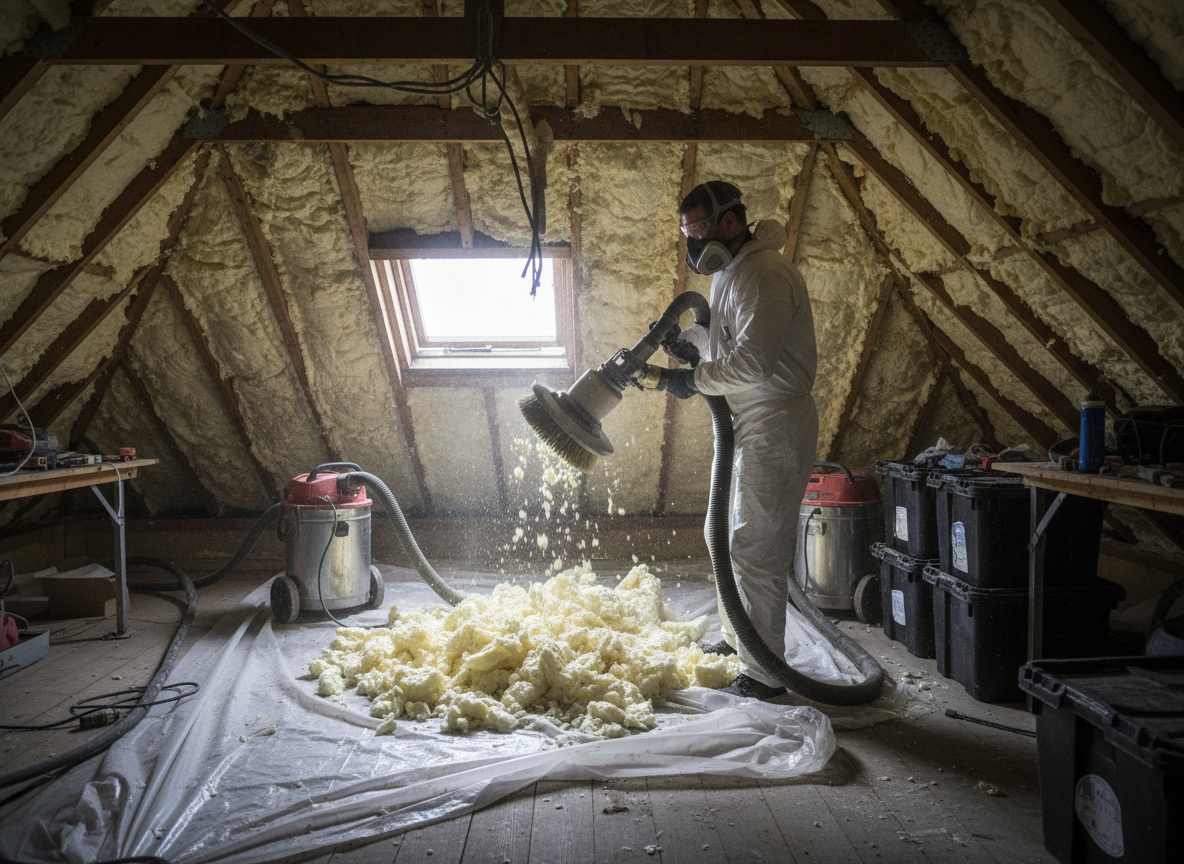
Open cell spray foam bonds aggressively to timber joists and older ceiling finishes common in Scunthorpe's post-war semis and Victorian terraces. Removal requires careful mechanical separation and negative-air containment to avoid forcing residue into living spaces below, especially where lath and plaster ceilings remain. Lincolnshire's frequent winter damp means any missed foam pockets can trap moisture against rafters, leading to rot that only shows months later.
Homeowners in areas like Ashby and Crosby often discover the foam was installed over existing insulation or electrical cables, creating hidden fire and access issues. We cut the foam in controlled sections, bag it on site, and vacuum the rafters before disposal, checking for original ventilation paths that must be restored to meet current building standards. The process takes longer in narrow lofts typical of terraced housing along the A18 corridor.
After extraction we always inspect for timber staining and test rafter moisture levels, because open cell foam in Scunthorpe lofts frequently conceals previous water ingress from valley gutters or failed ridge tiles. Leaving any residue behind risks future condensation problems once the loft returns to its original ventilated state.
Common Edge Cases in Scunthorpe Lofts
Older properties around the town centre often have foam sprayed directly onto fragile plasterboard or between narrow joists spaced at 400 mm centres, requiring slower hand removal to prevent ceiling collapse. We also encounter foam that has expanded into eaves and blocked soffit vents, which must be cleared to restore airflow and prevent mould on the north-facing roof slopes common in this part of Lincolnshire.
Technician insight
In Scunthorpe, the thing that catches most people out with open cell spray foam removal is how tightly it bonds to the narrow joists in 1950s terraces around Crosby and Ashby, especially when previous owners blocked the eaves. Miss even a thin layer and condensation returns fast once the loft breathes again.
Foam Removal from a 1960s Semi in Bottesford
The homeowner noticed damp patches on bedroom ceilings after heavy winter rain. We found open cell foam had been sprayed over blocked soffit vents and into the eaves. We removed the foam in sections, cleared the vents, and restored airflow; the ceilings dried out without further intervention.
How it works
- 1
Site Assessment
We inspect the loft, check for hidden services and assess foam depth and adhesion to joists.
- 2
Containment Setup
Negative air machines and dust barriers are installed to protect the rooms below during cutting.
- 3
Foam Extraction
Foam is cut into sections, removed by hand and vacuumed, with rafters cleaned of residue.
- 4
Ventilation Restoration
Original airflow paths are reopened and any moisture issues flagged before handover.
Pricing
Cost depends on loft size, foam thickness and access difficulty; we provide clear quotes after inspection.