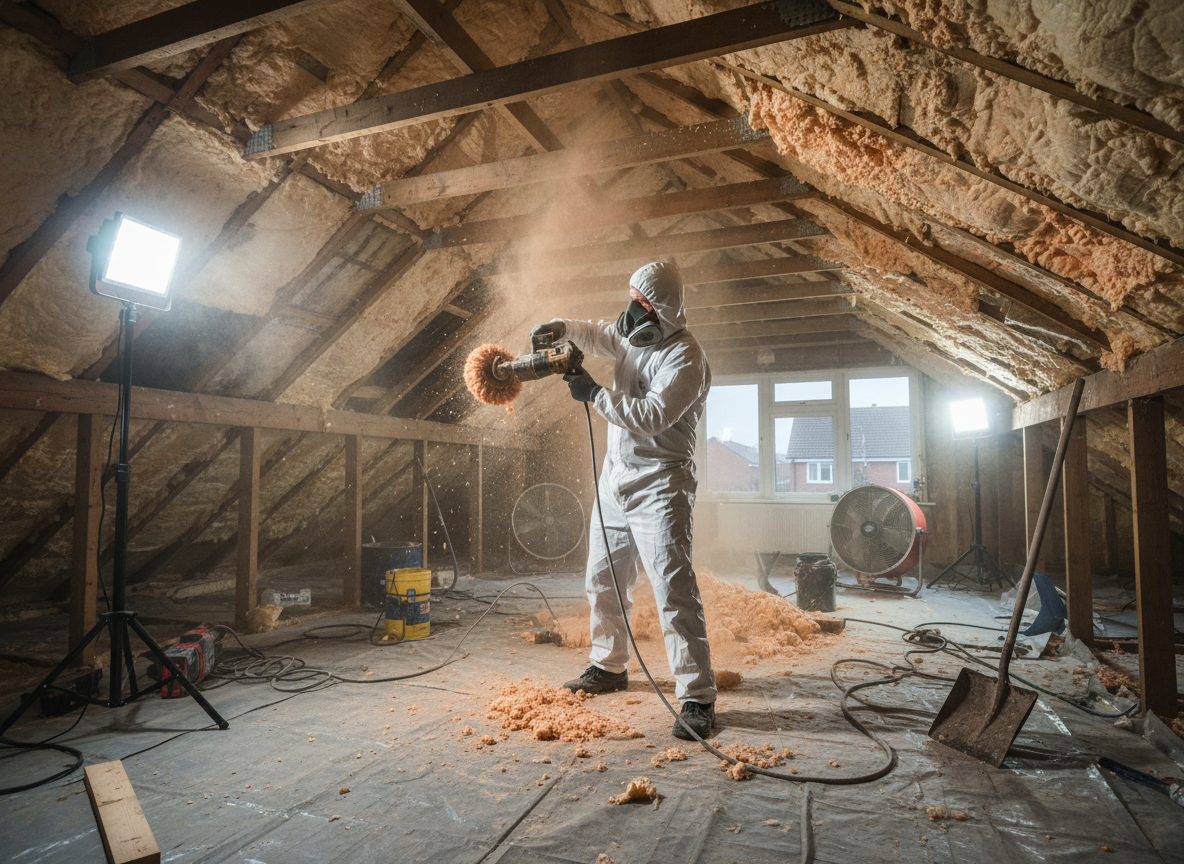
Spray foam removal in Scunthorpe often involves older post-war semis and terraced houses common along the A18 corridor and in neighborhoods like Crosby and Ashby. These properties frequently have limited loft access and timber joists that can be compromised by closed-cell foam bonded directly to the roof deck. Removal requires careful mechanical separation to avoid damaging original lath and plaster ceilings below, especially in homes built before the 1970s when ventilation standards were lower.
Lincolnshire's damp winters and occasional heavy rainfall increase moisture retention under spray foam, leading to hidden rot in rafters that only becomes visible once the foam is stripped. Crews working from our base on Doncaster Road must factor in narrow access hatches typical of Scunthorpe lofts and plan for dust containment to protect the rest of the house. Disposal follows local waste rules for expanded polyurethane, with loads taken to licensed sites rather than general landfill.
Edge cases include hybrid installations where foam was applied over existing mineral wool, creating mixed waste streams that need separation on site. In Gunness and nearby villages, properties with low-pitched roofs demand extra scaffolding or internal platforms because standard ladders cannot reach the eaves safely. Homeowners should expect the job to generate significant debris volume, requiring multiple trips from the van parked on the street.
Technician insight
In Scunthorpe, the thing that catches most people out with spray foam insulation removal is how often the foam has trapped condensation against the original felt in 1960s and 70s roofs along roads like Doncaster Road. Once stripped you find the rafters have started to soften, and that changes the job from simple extraction to having to advise on ventilation upgrades before any new insulation goes back in.
Crosby Semi Loft Strip-Out
Homeowner in Crosby called after noticing musty smells in the bedrooms below a 1970s loft. We found closed-cell foam fully bonded to the roof deck with visible moisture staining on several rafters. After mechanical removal and waste clearance we opened up the eaves vents and recommended improved airflow before any replacement insulation.
How it works
- 1
Initial Loft Inspection
Assess foam type, depth, roof condition and access points in Scunthorpe properties.
- 2
Containment Setup
Seal stairwell and rooms below to control dust and debris during removal.
- 3
Mechanical Foam Extraction
Cut and peel foam from rafters and decking using specialist tools without damaging timbers.
- 4
Waste Removal and Disposal
Bag and transport all material to licensed facilities serving the DN15 postcode area.
- 5
Final Clean and Ventilation Check
Vacuum residues and confirm loft ventilation meets current standards before handover.
Pricing
Cost varies with loft size, foam thickness, access difficulty and whether additional timber repairs are needed; site visit required for accurate quote.